
Medicaid Work Requirements Accelerate as States Prepare for 2027 Rollout
Efforts to implement Medicaid work requirements are intensifying nationwide as states prepare for a federally mandated rollout on January 1, 2027, under the One Big Beautiful Bill Act (OBBBA). The law ties eligibility for many adults in the Affordable Care Act (ACA) Medicaid expansion population to work or community engagement requirements, marking one of the most significant policy changes to the program in years. According to KFF, the policy establishes a national framework that states must operationalize within a compressed timeline. 1
This transition follows closely behind the recent Medicaid “unwinding” period, during which states resumed eligibility redeterminations after the COVID‑19 continuous coverage requirement ended. During that process, more than 25 million people were disenrolled, underscoring the scale and administrative complexity of nationwide eligibility changes. KFF analyses show that many individuals lost coverage due to procedural issues, not ineligibility, demonstrating how administrative barriers can drive coverage loss. 1
Under the new policy, eligible adults must complete at least 80 hours per month of qualifying activities, such as employment, education, job training, or volunteer work, to maintain coverage. These requirements apply across the 41 Medicaid expansion states and Washington, D.C., as well as partial expansion states like Georgia and Wisconsin. 2
State Implementation Gains Momentum
With roughly an 18‑month implementation window, states are rapidly building the infrastructure needed to administer the new rules, including IT upgrades, verification systems, and outreach strategies. 1
KFF survey findings indicate that many states are prioritizing automated data matching systems to verify compliance and exemptions and reduce reliance on manual reporting. 3 Implementation approaches vary widely, with states still making key policy decisions amid evolving federal guidance. 4
According to HFMA, states may request delayed implementation if they demonstrate good-faith efforts to comply, though most are working toward full implementation by 2027. 5
Coverage Loss Estimates Raise Concerns
Analyses project substantial coverage impacts. Estimates cited by KFF and HFMA suggest that millions of individuals could lose Medicaid coverage, with projections ranging from 3 million to more than 5 million people over time. 5
Research consistently shows that administrative complexity, not unwillingness to work, drives much of the coverage loss associated with these policies. Prior state demonstrations found that many eligible individuals were disenrolled because they were unaware of requirements or unable to navigate reporting systems. 2 These patterns closely mirror outcomes observed during Medicaid unwinding.
Hospitals Face Expanding Administrative Roles
Hospitals and providers are expected to play a key role in supporting implementation, particularly in verifying exemptions and assisting with eligibility documentation. 5
Key responsibilities are likely to include:
- Documenting medical frailty or disability exemptions
- Supporting eligibility verification for temporary hardship exemptions, such as hospitalizations
- Assisting patients with compliance documentation and reporting requirements
KFF survey findings indicate that many states are exploring self-attestation models supported by provider documentation, though accurately identifying exempt individuals remains a challenge. 3
States With Current or Upcoming Medicaid Work Requirements
Currently active
-
Georgia (since 2023, via Section 1115 waiver; only active waiver-based program)
-
Nebraska (effective May 2026; first state implementing federal requirements early)
Early or emerging implementation activity (pre‑2027)
Multiple states are exploring or preparing early implementation strategies under the new law, though specific start dates vary and remain subject to federal approval and state readiness.
-
Montana (planned July 1, 2026; early rollout in progress)
-
Iowa (planned December 1, 2026; aligning with federal guidance)
Nationwide requirement (by January 1, 2027)
- All Medicaid expansion states (41 states + Washington, D.C.) must implement work requirements for applicable adult populations, subject to exemptions
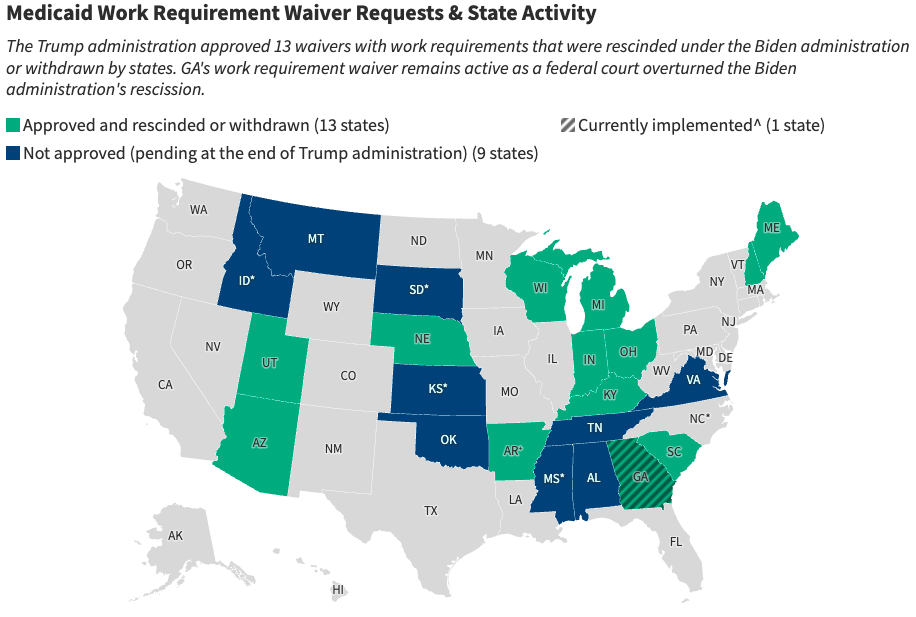
The KFF map shows that while Medicaid work requirements were widely pursued during Trump's first administration, most were later halted or reversed. Thirteen approved waivers were rescinded or withdrawn, and nine additional requests were never approved. As a result, Georgia remained the only state to implement a work requirement via a Section 1115 waiver following a federal court ruling.
This reflects a broader shift away from state-led work requirements from 2018–2024. That trend is now reversing: beginning in 2026, states such as Nebraska have begun implementing work requirements under new federal law mandating nationwide adoption by January 1, 2027.
Medicaid Work Requirement Activity
- 13 states had Medicaid work requirement waivers approved during the Trump administration, but these were later rescinded or withdrawn under the Biden administration or by states themselves.
- 9 states had waiver requests that were not approved before the end of that administration.
- Georgia was the only state to implement a waiver-based Medicaid work requirement; however, Nebraska began implementing work requirements in May 2026 under the new federal law.
Variation Across States Adds Complexity
States have significant flexibility in implementation, leading to variation in verification frequency, exemption criteria, and enforcement approaches. Many plan semiannual compliance checks, while others are considering stricter or more frequent verification. 3
This variability is expected to create a fragmented compliance landscape, particularly for multi-state providers and managed care organizations.
Operational and Financial Implications
Hospitals are preparing for downstream effects, including potential increases in uncompensated care and financial strain. Analysis from the Commonwealth Fund finds that Medicaid work requirements could significantly reduce hospital revenues and operating margins, especially for safety-net providers. 6
In response, many health systems are:
- Expanding eligibility screening and financial counseling
- Enhancing patient outreach and education
- Identifying populations at risk of losing coverage
Bottom Line
Medicaid work requirements represent a major shift in eligibility policy with far-reaching implications for states, providers, and patients. As implementation accelerates, hospitals are emerging as key partners in compliance and patient support.
While policymakers aim to encourage workforce participation and reduce federal spending, evidence suggests that administrative complexity will ultimately determine coverage outcomes, with millions at risk of losing coverage despite remaining eligible.
For more than 45 years, Elevate Patient Financial Solutions® has delivered exceptional revenue cycle management services to healthcare providers nationwide. Its comprehensive solutions drive optimal financial performance while improving patient experience. ElevatePFS® services include Medicaid Eligibility & Disability Enrollment, Revenue Cycle Analytics, Third Party Liability, Workers’ Compensation, Veterans Affairs, Out-of-State Eligibility, Denials Management, Extended Business Office Engagements, including A/R Services, Low Balance Insurance Follow Up, Zero Balance Payment Recovery, Legacy Receivables account resolution and Self-Pay/Early Out Billing & Collections. ElevatePFS has earned the HFMA Peer Review designation for over 15 years, achieved Great Place to Work® certification for four consecutive years, received the 2025 Best in KLAS recognition for Eligibility and named a #1-rated vendor for self-pay, charity care, Medicaid screening and eligibility enrollment services in the 2026 Black Book Research rankings. With a 95% client retention rate, ElevatePFS is a trusted, proven partner for sustainable revenue recovery and patient-centered financial engagement.
Legal Disclaimer: This article is for general informational purposes only and is not legal advice. Clients should consult their own legal counsel regarding how these developments may affect their specific Medicaid population and operations.
Sources
- https://www.kff.org/medicaid/medicaid-work-requirements-tracker-overview/
- https://www.kff.org/medicaid/a-closer-look-at-the-work-requirement-provisions-in-the-2025-federal-budget-reconciliation-law/
- https://www.kff.org/medicaid/survey-offers-early-look-at-states-differing-approaches-to-implementing-medicaid-work-requirements-amid-cost-and-time-constraints-and-uncertainty-from-delayed-federal-guidance/
- https://kffhealthnews.org/medicaid/medicaid-work-requirements-kff-survey-state-implementation-strategies/
- https://www.hfma.org/payment-reimbursement-and-managed-care/medicaid-work-requirement-hospital-impact/
- https://www.commonwealthfund.org/publications/issue-briefs/2025/sep/impact-medicaid-work-requirements-hospital-revenues-margins